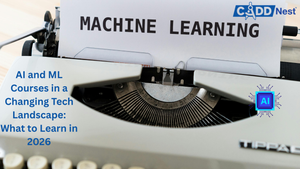
Looking for best coaching institute for AI & ML courses? Google CADD Nest Academy to explore in the era where: Artificial intelligence and machine learning have moved from specialist research topics to everyday workplace tools. In 2026, a marketing team uses generative models to draft campaigns, a hospital uses predictive models to triage patients, and a logistics company uses forecasting systems to plan routes. For anyone thinking about a career move, a promotion, or a first step into technology, the question is no longer whether to learn AI and ML. It is which course, which skills, and in what order.
This guide explains how the landscape has changed, what kinds of AI and ML courses exist today, which skills employers actually value, and how to choose a program that fits your goals and your schedule.
How the AI and ML Landscape Has Changed?
A few years ago, an AI course usually meant a long stretch of linear algebra, classical algorithms and model training from scratch. Those foundations still matter, but the surrounding landscape has shifted in four important ways.
Generative AI is now mainstream. Large language models, image models and multimodal systems are embedded in search engines, office software, design tools and customer support platforms. Courses that ignore them feel dated. Learners now expect to understand how these models work, how to prompt them well, and how to build products on top of them.
Applied skills matter more than theory alone. Employers increasingly ask whether a candidate can ship something: a working chatbot, a recommendation engine, a dashboard that predicts churn. Pre-trained models and open-source libraries have lowered the barrier to building, which raises the bar for judgment, evaluation and deployment.
AI literacy is no longer limited to engineers. Product managers, marketers, designers, lawyers, teachers and founders all need a working understanding of what AI can and cannot do. This has created a new category of short, non-technical courses alongside the traditional technical tracks.
Responsibility and governance have become part of the job. Questions about bias, privacy, copyright, transparency and security now appear in procurement checklists and regulations. A modern course should treat them as core content, not as an optional final lecture.
The practical consequence is that the best learning paths in 2026 blend durable fundamentals with hands-on work on current tools. Chasing every new model release is a losing game, but ignoring the changes is just as risky.
Types of AI and ML Courses Available Today
The market is crowded, so it helps to sort courses into categories prior comparing individual programs.
1. AI literacy and foundations courses
These are short programs, often a few hours to a few weeks, aimed at beginners and non-technical professionals. They explain core ideas such as training data, models, prediction, generative AI and limitations like hallucination. They are ideal for managers, entrepreneurs and anyone who wants to work confidently with AI teams or tools without writing code.
2. Machine learning fundamentals
These courses teach supervised and unsupervised learning, regression, classification, clustering, model evaluation and feature engineering, usually in Python. They remain the best starting point for anyone who wants a technical career because the same concepts underpin more advanced systems.
3. Deep learning and neural networks
Building on the fundamentals, these courses cover neural network architectures, convolutional networks for images, sequence models, transformers and training techniques. They typically use frameworks such as PyTorch or TensorFlow and require comfort with Python and basic mathematics.
4. Generative AI and large language model courses
This is the fastest-growing category. Topics include how transformers work, prompt design, fine-tuning, retrieval-augmented generation, agents and tool use, evaluation of model outputs, and building applications with model APIs. Strong programs spend as much time on evaluation and safety as on building.
5. MLOps and deployment courses
Training a model is only a fraction of the work. MLOps courses cover data pipelines, version control for models, containerization, cloud deployment, monitoring and retraining. Because many organizations struggle to move from prototype to production, these skills are in steady demand.
6. Domain-specific AI courses
AI for healthcare, finance, manufacturing, design, real estate, marketing and education is increasingly popular. These courses pair core techniques with industry data and problems, helping professionals apply AI inside the field they already know.
7. Degrees, bootcamps and professional certificates
University master’s programs offer depth and credibility. Bootcamps offer speed and structure, often with career support. Professional certificates from universities and technology companies sit in between and are popular with working professionals. None is universally best; the right format depends on your time, budget and starting point.
Major Skills Worth Learning in 2026-27
Whatever format you select, the following skills form the backbone of a strong AI and ML education.
Python and data handling. Python remains the working language of the field. Learn to clean, explore and visualize data with libraries such as NumPy and pandas before touching complex models. Most real-world project time goes into data preparation.
Mathematics and statistics, at the right depth. You do not need a mathematics degree, but you do need working intuition for probability, distributions, linear algebra, gradients and the idea of overfitting. This intuition helps you debug models and question results.
Core machine learning workflow. Understanding how to split data, train, validate, tune and evaluate a model is the most transferable skill in the field. It applies whether the model is a simple regression or a large neural network.
Working with foundation models. Learn how to use pre-trained models through APIs and open-source releases, how to write effective prompts, how to ground answers in your own documents with retrieval techniques, and how to test outputs systematically.
Evaluation and critical thinking. Perhaps the most underrated skill. Knowing when a model is wrong, biased or simply unreliable separates dependable practitioners from enthusiastic hobbyists.
Deployment and tooling. Basic cloud familiarity, APIs, version control and containerization help you turn notebooks into usable products.
Ethics, privacy and governance. Understanding data protection, fairness and responsible use is increasingly part of the job description, especially in regulated industries.
Communication. Explaining a model’s value and limits to non-technical colleagues is a genuine career advantage. Courses that include presentations or case studies build this skill.
How to Choose the Right AI or ML Course
With hundreds of options, a simple decision framework can save time and money.
Start with your goal. Do you want to become a machine learning engineer, add AI to your current role, start an AI-enabled business, or simply stay informed? A career switcher needs depth and projects; a manager needs literacy and strategy.
Check prerequisites honestly. Some courses assume strong programming and mathematics. Others start from zero. Choosing a course that is too advanced leads to frustration; one that is too basic wastes time.
Look for project-based learning. A course that ends with a portfolio of two or three real projects is worth more than one that ends only with a quiz. Projects give you something concrete to show employers or clients.
Review how current the curriculum is. Look for recent updates, coverage of generative AI, and instructors who work in the field. Be cautious of programs built entirely around tools that may be obsolete within a year.
Evaluate the instructors and community. Experienced practitioners, active discussion forums, mentorship and peer groups make a large difference, especially for self-motivated learners who still need feedback.
Consider the format and schedule. Self-paced courses offer flexibility, while cohort-based programs offer accountability. Working professionals often prefer weekend or evening schedules.
Understand the credential. Certificates help most when they come from recognized institutions, but employers often weigh demonstrated skills more heavily than a certificate alone.
Compare total cost and value. Free and low-cost courses are excellent for exploration. Paid programs can justify their price through mentorship, structure and career support, but ask for syllabus details and honest outcome information before enrolling.
Career Trajectory Opened by AI and ML Skills
The skills above lead to a wide range of roles, and not all of them are purely technical.
- Machine learning engineer: builds, trains and deploys models in production systems.
- Data scientist: analyzes data, builds predictive models and communicates insights to the business.
- AI application developer: creates products using language and vision models through APIs.
- Data analyst with AI skills: uses modern tools to automate analysis and reporting.
- MLOps or platform engineer: maintains the infrastructure that keeps models reliable.
- AI product manager: defines what to build and how to measure success.
- AI-enabled specialist: a marketer, designer, consultant, writer or operations lead who uses AI to deliver faster and better results in an existing field.
That last category is the largest and usually overlooked. Many professionals will not become engineers but will become dramatically more effective by mastering AI tools in their own domain.
Predominant Mistakes to Avoid
Collecting certificates instead of building things. Credentials without projects rarely convince anyone.
Skipping fundamentals. Jumping straight to advanced tools leaves gaps that surface later, usually at the worst moment.
Chasing every trend. New models and frameworks appear constantly. Anchor your learning in concepts that last and treat tools as replaceable.
Ignoring data quality. A sophisticated model trained on poor data produces poor results. Learn to inspect and clean data carefully.
Underestimating ethics and security. Mishandling personal data or deploying an unvetted model can cause real harm and legal trouble.
Learning alone for too long. Feedback from mentors and peers speeds progress and keeps motivation high.
Looking Ahead
The technology will keep evolving, and today’s cutting-edge tool will be tomorrow’s baseline. What will not change is the value of people who understand data, think critically about models, and apply AI responsibly to real problems. The most resilient learners are those who treat education as a continuing habit rather than a single course.
Whether you are a student, a career switcher or an established professional, 2026 offers an unusually rich set of options for learning AI and ML. Define your goal, pick a program that emphasizes hands-on work and current practice, and begin building. The best time to start was a few years ago; the second best time is now.
Frequently Asked Questions (FAQs)
1. Do I need a coding background to start an AI or ML course?
Not necessarily. AI literacy courses require no coding and suit managers, marketers and entrepreneurs. For technical tracks, basic Python is helpful, and many beginner courses teach it from scratch. If you plan to become an engineer or data scientist, expect to build programming skills alongside the AI concepts.
2. How long does it take to become job-ready in AI and ML?
It depends on your starting point and the role. A motivated beginner studying consistently can build a solid foundation and a small portfolio in roughly nine to twelve months. People with programming or analytics experience can move faster. Roles that add AI skills to an existing profession can take only a few months of focused practice.
3. Are free AI courses good enough, or should I pay for one?
Free and low-cost courses are excellent for learning fundamentals and testing your interest. Paid programs are worth considering when you want structure, mentorship, feedback on projects, career support or a recognized credential. Whatever you choose, judge the course by its curriculum, projects and instructors rather than its price.
4. Will AI replace the jobs that AI and ML courses prepare me for?
AI is changing how technical work is done, automating routine coding and analysis tasks, but it also creates demand for people who can design, evaluate, deploy and govern these systems. Professionals who combine technical understanding, domain knowledge and good judgment are generally better positioned than those who rely on a single narrow skill. Continuous learning is the best protection.
5. Which is better: a university degree, a bootcamp or a short online course?
There is no single best option. A degree offers depth, research exposure and institutional credibility but takes the most time and money. A bootcamp offers fast, structured, career-focused training. Short online courses and certificates are flexible and affordable, and they suit working professionals. Many people combine them, for example starting with an online course to confirm their interest before committing to a longer program.