Python is still the most in-demand programming language for beginners and working professionals. It’s no longer just a “first language.” It now sits behind AI products, business dashboards, web platforms and automation tools that companies in Bengaluru depend on every day.
If you’re planning a tech career, these are the Python trends worth knowing, and the skills that will keep you employable.
1. Python and Generative AI
Generative AI has moved from experiment to everyday business tool. Python is the main language for building with it. Chatbots, document assistants, content tools and recommendation engines are mostly written in Python, using libraries like PyTorch, TensorFlow, Hugging Face Transformers and LangChain.
What to learn: Python fundamentals, NumPy and Pandas, machine learning basics, and how to connect applications to AI models through APIs.
2. Agentic AI and Workflow Automation
Companies increasingly want AI systems that don’t just answer questions but complete multi-step tasks: pulling data, sending reports, updating records. Python is the glue language for these systems, and many entry-level roles now involve building and maintaining them.
What to learn: API handling, scripting, working with JSON and databases, and task scheduling.
3. Data Analytics and Data Science
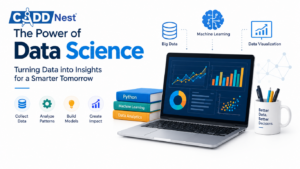
Every industry in Bengaluru, from IT services and fintech to healthcare and retail, relies on data. Python’s ecosystem (Pandas, Matplotlib, Seaborn, Scikit-learn) remains the standard for cleaning, analysing and visualising it. Python also pairs well with SQL, Excel and Power BI, which most analyst roles ask for.
What to learn: Pandas, data visualisation, SQL, statistics, and building a portfolio of real datasets.
4. Python for Web Development
Django and Flask are still widely used, while FastAPI has become popular for building fast, modern APIs. Python full stack developers who can pair a Python back end with a front end (HTML, CSS, JavaScript, React) are especially valuable to startups and product companies.
What to learn: Django or FastAPI, REST APIs, databases, Git, and deployment basics.
5. A Faster, More Modern Python
Python itself keeps improving. Recent versions bring better performance, clearer error messages, stronger type hints and experimental support for running without the Global Interpreter Lock, which could unlock better multi-core performance over time. Newer tools like Ruff and uv are also making Python projects quicker to set up, lint and manage.
What to learn: Clean coding habits, type hints, virtual environments and modern project tooling.
6. Cloud, DevOps and Cybersecurity
Python is widely used for cloud automation, infrastructure scripts, testing and security tasks such as log analysis and vulnerability scanning. Professionals who can write reliable Python scripts have an edge in cloud and DevOps roles.
7. Python in Engineering, IoT and Industry
Python is also growing in automation, simulation and IoT. Engineers and design professionals use it to automate repetitive work, process sensor data and extend design software.
How to Turn These Trends Into a Career
Knowing the trends is the easy part. Employers hire people who can build things. A good Python learning path looks like this:
- Master the fundamentals: syntax, data structures, OOP, file handling.
- Pick a direction: full stack development, data analytics, data science, or AI & ML.
- Build projects: a dashboard, a REST API, a prediction model, an automation script.
- Learn the supporting tools: Git, SQL, cloud basics.
- Prepare for interviews: coding practice, mock interviews and a strong portfolio.
Learn Python the Practical Way at CADD Nest Academy, Bengaluru
At CADD Nest Academy, our programs are built around hands-on, job-oriented learning. Whether you’re a student, a fresher or a working professional switching careers, you can choose the path that fits your goal:
- Python Full Stack: build complete web applications from front end to back end
- Data Analytics: turn raw data into business decisions
- Data Science: work with statistics, modelling and real datasets
- AI & ML: build intelligent applications with modern tools
With project-based training and guidance from experienced trainers, you graduate with skills and a portfolio you can show to employers, not just a certificate.
Ready to start? Contact CADD Nest Academy, Bengaluru, to book a free demo class and talk to our counsellors about the right Python course for you. [Add phone / WhatsApp / address here]
Frequently Asked Questions
1. Is Python still worth learning in 2026?
Yes. Python remains one of the most widely used languages for AI, data, web development and automation, and demand for Python skills across these areas continues to be strong.
2. Can a beginner with no coding background learn Python?
Absolutely. Python’s readable syntax makes it one of the easiest languages to start with, and a structured course takes you from basics to projects step by step.
3. Which Python course is best for me: Full Stack, Data Analytics, Data Science or AI & ML?
It depends on your goal. Choose Full Stack to build web applications, Data Analytics for business and reporting roles, Data Science for modelling and deeper statistics, and AI & ML to build intelligent systems. Our counsellors can help you decide.
4. How long does it take to learn Python well enough to get a job?
This varies by course and the effort you put in. Consistent practice and project work matter more than speed. Ask our team about the duration of your chosen program.
5. Does CADD Nest Academy offer placement support?
We offer career-focused training including portfolio building and interview preparation. Please contact our team for details on current placement assistance.